How to Actually Compute Your Property's Value in the Philippines
By Aaron Zara
Grab your tax declaration and your title. That's where we start.
Not a textbook definition. Not a formula you'll never use. Just the actual process I walk my clients through when they ask me, "How much is my property worth?"
I'm a licensed real estate broker, and I've been in the Philippine real estate industry for over a decade. Before that, I worked as a software engineer at HDB (Singapore's Housing and Development Board) and lived in Ang Mo Kio, walking distance from AMK Hub. I'm going to tell you why that matters in a moment, because the difference between how Singapore handles property valuation and how we do it here in the Philippines is the reason this guide needs to exist.
Most articles you'll find online about computing property value in the Philippines read like they were copied from a real estate textbook, or worse, generated by AI. They'll give you three valuation approaches (cost, sales comparison, income), list some generic factors like "location matters," and wrap up with "consult a professional."
That's not helpful. So let me show you what actually works.
Step 1: Look Up Your Zonal Value
Your first reference point is the BIR zonal value. This is the government's floor price for your land, the minimum value per square meter that the Bureau of Internal Revenue assigns to every zone in the Philippines.
Here's what you do: go to your barangay's page on Ren.ph. Every barangay page has an interactive calculator built in. Select your street from the dropdown, choose your property classification (residential, commercial, agricultural, etc.), enter your lot area in square meters, and the tool computes your zonal value basis and capital gains tax automatically.
For example, try White Plains in Quezon City. Select "WHITE PLAINS SUBD (KATIPUNAN AVE.)" from the street dropdown, set the property type to Residential (PHP 138,000/sqm in this subdivision), punch in 250 square meters, and you'll immediately see: zonal basis of PHP 34,500,000, capital gains tax at 6% (PHP 2,070,000), and documentary stamp tax at 1.5% (PHP 517,500). Estimated total tax burden: PHP 2,587,500. You get all of that before you even talk to a broker or an accountant.
Notice how much the classification matters within the same area. That same lot in White Plains could have a completely different zonal value depending on the street or if it's classified differently. That's why knowing your exact street and zoning matters before anything else.
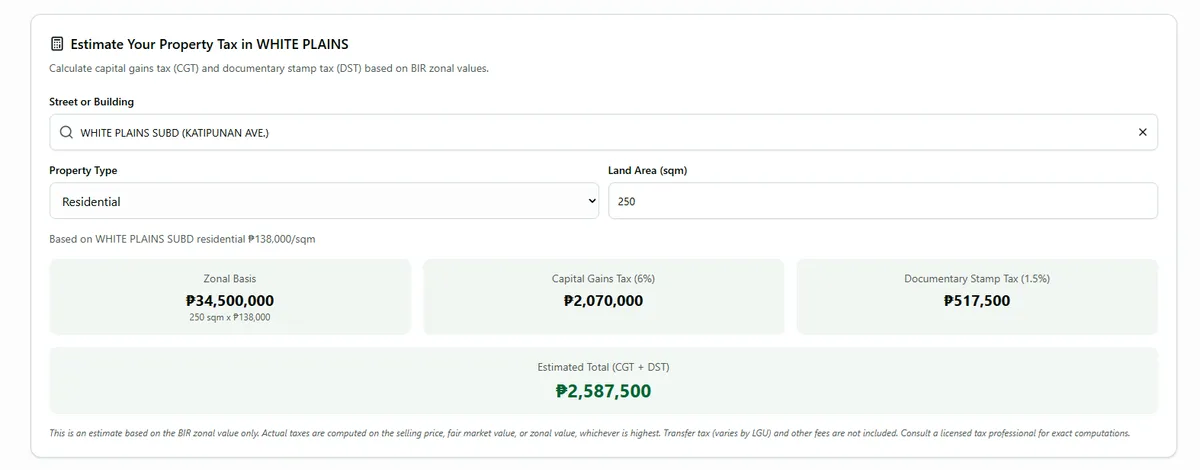
What this number means: The zonal value is the BIR's minimum fair market value for your land. It's the basis for computing capital gains tax (6%), documentary stamp tax (1.5%), and transfer tax when you sell. Here's the important part: if you sell your property below zonal value, the BIR will still tax you based on the zonal value, not your selling price. The calculator on Ren.ph already does this math for you, so you know your tax exposure before you even start negotiating.
What this number doesn't mean: This is not your property's market value. In most areas, especially those with strong demand, the actual market value is significantly higher than the zonal value. In some cases, I've seen the gap as wide as 3x to 5x. In stagnant areas, the market value might only be 10-20% above zonal.
Think of zonal value as the floor, not the ceiling. Now we need to figure out where between the floor and the ceiling your property actually sits.
Step 2: Find Comparable Sales (And Why This Is the Hard Part)
This is where things get messy. And to explain why, let me tell you about Singapore.
I used to work as a software engineer at HDB in Singapore. On my last year there, I lived in Ang Mo Kio, walking distance from AMK Hub. Over there, if you want to know what a flat sold for, you open the HDB Resale Flat Prices portal, select your flat type, pick your town from a dropdown of 27 HDB towns, and every registered resale transaction is right there: price, block, street, floor area, flat model, lease commence date. The data is updated daily. You can filter by date range, block number, even price range. And if you want a map view, their HDB Map Services lets you search resale transacted prices within 200 meters of any HDB block. Past data going back to 1990 is available on data.gov.sg. Finding comparables in Singapore takes about 30 seconds.
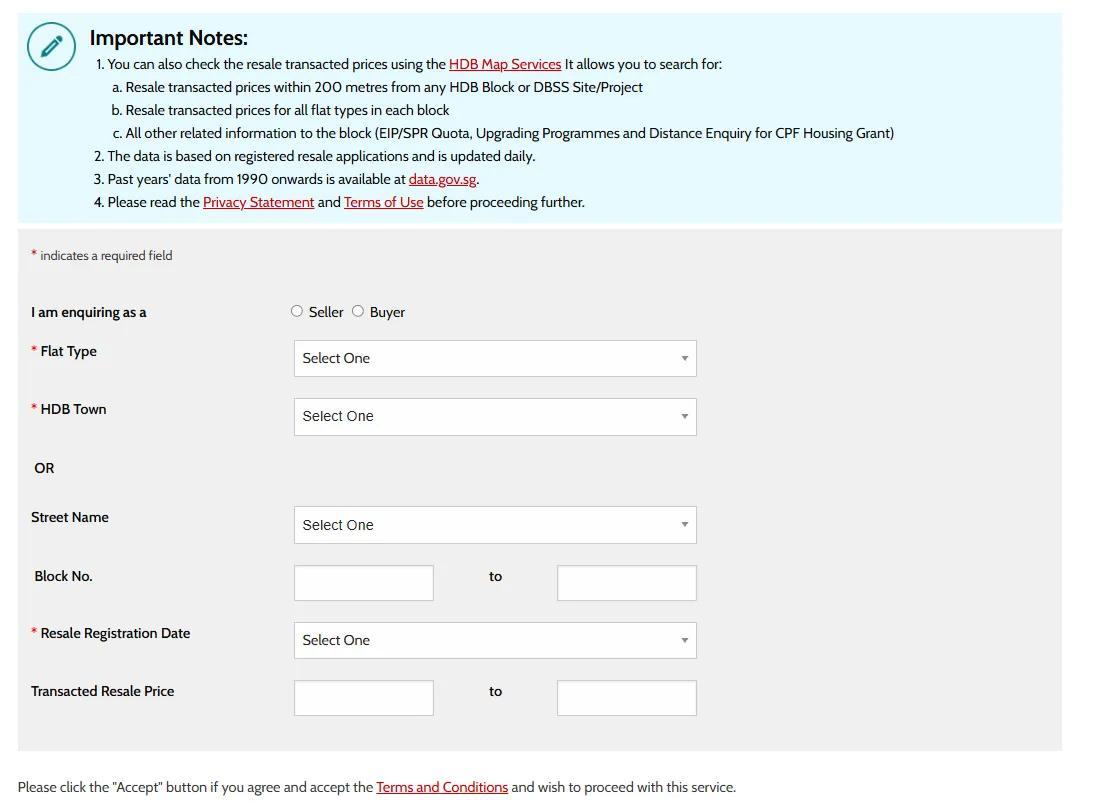
Private portals like 99.co build automated valuation models on top of this public data with claimed 98% accuracy. That's only possible because the underlying transaction data is public and comprehensive.
Back here in the Philippines, we have nothing like that. No centralized transaction database. No public record of what your neighbor's lot actually sold for. The BIR publishes zonal values. The Registry of Deeds records transfers buried in annotation pages. And brokers share numbers informally over coffee. So when I walk you through finding comparables below, understand that this isn't a 30-second lookup. It's investigative work. And that's exactly why knowing the process matters.
Here's how to actually find comparable sales:
Check online listings, but discount them heavily. Lamudi, Carousell, OnePropertee, Facebook Marketplace. These are your starting points for seeing what's listed in your area. But here's what most people don't realize: listing prices in the Philippines are almost always inflated. Sellers list high expecting to negotiate down. The actual transaction price is typically well below what you see online.
If a 200sqm lot in your area is listed at PHP 15,000/sqm on Lamudi, the real transaction price is probably closer to PHP 10,500-12,000/sqm. That's a rough range, not a precise number, but it's more realistic than the listing price.
Buy a softdrink at the nearest sari-sari store. This is my personal move, and it might sound counterintuitive, but it works. If you know a property nearby that recently sold and you want to find out the price, walk over to the closest sari-sari store. Buy a Coke and some snacks. Strike up a conversation with the store owner. Ask casually if they know how much that lot down the street sold for. Sari-sari store owners are the unofficial intelligence network of every barangay. They hear the chika. They know who sold, who bought, and usually how much. Sometimes they go even further: they'll tell you the buyer's profile, what the plans are for the property, or even tip you off about other properties for sale in the area that haven't been listed anywhere yet. A PHP 40 softdrink and some small talk can save you from a PHP 500,000 pricing mistake.
Talk to the barangay. Barangay officials, particularly the captain and the secretary, often know about recent land sales in the area. They process clearances and other documents that give them informal visibility into transactions. A respectful conversation can yield useful data points. You can also check with the city or municipal assessor's office, which handles Certificates of No Improvement and has records of property transfers in the area.
Check Registry of Deeds annotations. If you have access to the titles of neighboring properties (or can request certified true copies), look at the annotations on the back of the title. These sometimes record the sale price, though this is hit-or-miss. Many transactions are annotated at zonal value rather than actual price to minimize taxes.
Ask local brokers. Licensed brokers who are active in your area have the best comparable data. They know what properties actually sold for, not just what they were listed at. This is one of the reasons working with a broker has value beyond just marketing your property. They carry market intelligence that simply isn't available in any database. Find a broker in your area on Ren.ph.
Check developer prices for benchmarking. If there are subdivision developments or condo projects near your property, check their published price lists. Developer prices for new units give you a ceiling for the area. Resale prices for existing properties in the same development give you a tighter range.
Step 3: Adjust for Differences
You've found 3-4 comparable properties. Now here's the thing no textbook tells you: those comparables are never identical to your property. They differ in size, location, condition, road access, and a dozen other factors. You need to adjust.
Let me walk you through a realistic example. Not the clean textbook version with round numbers, but the kind of messy comparison you'll actually encounter.
A Real-World Comparable Analysis
Say you're trying to value a 200sqm residential lot in a barangay in Bacoor, Cavite. You've found three comparables:
Comparable A: 180sqm lot, same barangay, sold 3 months ago for PHP 12,000/sqm. Corner lot with two road frontages. Inside a gated subdivision.
Comparable B: 250sqm lot, adjacent barangay, sold 5 months ago for PHP 9,500/sqm. Interior lot (not on the main road). Near a creek that floods during heavy rain.
Comparable C: 200sqm lot, same barangay, listed (not sold) at PHP 14,000/sqm on Lamudi 2 months ago. Mid-block, regular shape. Listing is still active and hasn't sold.
Here's how I'd think through each one:
Comparable A is a corner lot in a gated subdivision. Those typically command a premium. If I'm comparing it to a mid-block lot outside a subdivision, I'd adjust the price downward by maybe 10-15% for the corner lot advantage and another 5-10% for the subdivision premium. That brings PHP 12,000 down to roughly PHP 9,600-10,200/sqm.
Comparable B is near a flood-prone creek. Flood risk depresses values. I'd adjust upward from PHP 9,500 by 15-20% to estimate what it would sell for without the flood risk. That gives us roughly PHP 10,900-11,400/sqm. But it's also in an adjacent barangay, not the same one, so there might be a location adjustment too, depending on which barangay is more desirable.
Comparable C hasn't actually sold. It's just a listing. I can note it as a data point, but I'd discount the asking price by at least 20%. So PHP 14,000 becomes roughly PHP 11,200/sqm as an estimated transaction price. And even that's generous. The fact that it hasn't sold after 2 months suggests the price is too high for the market.
Triangulating: After adjustments, my three data points suggest a range of roughly PHP 9,600 to PHP 11,400/sqm for my subject property. The midpoint is around PHP 10,500/sqm. For a 200sqm lot, that's approximately PHP 2,100,000.
Is this precise? No. Is it a defensible estimate based on available data? Yes. And it's far more honest than plugging numbers into a formula and pretending you got an exact answer.
Common Adjustments You Should Know
Here are the adjustments I use most often in practice:
Corner lot vs. mid-block: Corner lots typically command 10-20% more. Dual road frontage means better visibility and access, which matters for both residential and commercial use.
Road frontage vs. interior lot: A property with direct road access is worth significantly more than a landlocked property. If the lot has no road frontage and requires an easement or right-of-way through another property, discount it by 20-40%. Right-of-way disputes are one of the biggest deal-killers in Philippine real estate. I've seen properties become essentially unsellable because of this.
Flood zone: Properties in flood-prone areas lose 15-30% of their value relative to comparable properties on higher ground. After Typhoon Ondoy, entire neighborhoods in Marikina and Cainta saw permanent value reductions. Check your municipal flood hazard map before buying.
Regular vs. irregular shape: A rectangular lot is easier to develop than a triangular or L-shaped lot. Irregular lots lose 5-15% depending on how buildable the shape is.
Age and time of sale: Property values change. A comparable that sold 12 months ago might not reflect today's market. In an appreciating market, adjust upward by 3-8% per year. In a flat market, use the price as-is.
Step 4: Cross-Check Against Your Tax Declaration
Now you have three numbers:
- BIR zonal value -- the government's floor price (from Step 1)
- Your estimated market value -- based on comparable sales (from Steps 2-3)
- The assessed value on your tax declaration -- what your LGU uses for real property tax
These three numbers will almost never match, and that's normal. Here's what the relationship between them tells you:
Market value is 30-80% above zonal value: This is the typical pattern in appreciating markets: Metro Manila, Cebu, Cavite, Laguna. It means demand is outpacing the BIR's last zonal update. Your property is likely a solid investment.
Market value is only 10-20% above zonal value: This happens in flat or declining markets, or in areas where the BIR recently updated zonal values (like the 2024 update under RMC 85-2024). It could also mean the market isn't as strong as you think. Be cautious about overpaying.
Market value is at or below zonal value: This is a red flag. It could mean there's a problem with the property (flood zone, title issue, access problem) that's suppressing market demand. Or it could mean the BIR zonal value is set too high relative to actual market conditions, which happens in some rural areas.
The assessed value on your tax declaration is a different computation entirely. LGUs assess properties based on their own schedule of fair market values, then apply an assessment level (percentage) to determine the assessed value for real property tax purposes. This number is almost always lower than both the zonal value and the market value. Don't use it as a proxy for what your property is worth.
The key insight: these three values exist because three different government agencies have three different reasons for valuing your property. The BIR wants to maximize tax revenue from transactions. The LGU wants a basis for annual property tax. And the market doesn't care about either of them. Understanding this relationship gives you leverage in any negotiation.
Step 5: Do You Need a Professional Appraisal?
Not always. Here's when you do:
You need one if:
- You're selling a property worth more than PHP 5 million. The cost of a professional appraisal is small relative to the risk of mispricing.
- A bank requires it for a mortgage or refinancing. Banks have their own panel of accredited appraisers, and they'll order one regardless of what you think the property is worth.
- You're involved in a legal dispute (estate settlement, expropriation, divorce). Courts require appraised values from licensed appraisers.
- You're a developer acquiring land for a project. The margin for error at scale makes professional appraisal essential.
You probably don't need one if:
- You're selling a residential lot worth under PHP 3 million in a well-known subdivision. Comparables are usually sufficient.
- You're doing a quick sanity check on a property you're considering buying. The process in Steps 1-4 above gives you a defensible range.
- You're just curious. Save the PHP 5,000-25,000 appraisal fee and use the free tools available.
A professional appraisal in the Philippines typically costs PHP 5,000-25,000 depending on the property type, size, and location. For properties valued above PHP 5 million, this is a small cost relative to the risk of pricing incorrectly.
The Honest Truth About Property Valuation
Here's what I want you to take away from this guide: computing your property's value in the Philippines is harder than it should be. The data infrastructure that makes valuation straightforward in countries like Singapore simply doesn't exist here. We don't have a centralized transaction database. We don't have automated valuation models built on actual sales data. We have zonal values, tax declarations, listing prices that are always inflated, and word-of-mouth from brokers and neighbors.
That's the reality, and pretending otherwise doesn't help you.
What does help is knowing the process: looking up your zonal value, hunting for comparables, adjusting for differences, and cross-checking against multiple reference points. It's not precise, but it's honest. And an honest estimate based on real data is infinitely more useful than a precise-looking number generated from a formula with no grounding in actual transactions.
This is also why I built Ren.ph. It won't give you a magic number, but it will give you organized zonal value data at the barangay level, a broker directory to connect you with professionals in your area, and educational resources to help you understand what your property is actually worth.
Because knowing your property's value isn't just a number. It's leverage. Whether you're buying, selling, negotiating, or planning, the person who understands the real value of the property on the table is the person in control of the conversation.
Aaron Zara is a PRC-licensed real estate broker and the founder of Ren.ph. He has over a decade of experience in Philippine real estate and previously worked as a software engineer at Singapore's Housing and Development Board (HDB).